
If you spend a lot of time learning grammar rules, you may be doing yourself a disservice, as many grammar rules are now okay to break! The rules we learned in school all those years ago? Evolution has rendered them useless. English is a language whose speakers adapt and manipulate to fit the speaker, and not the other way around. In general, Anglophones don't derive their identity from their language as many other cultures- such as the French. Instead, English is nothing more than a tool to be used by its speakers; it's not a part of our cultural heritage. I found the following article on the subject of English rules to be very interesting (and funny):
http://www.chicagotribune.com/features/life/ct-tribu-words-work-rulebreakers-20120919,0,4074825.story
Enjoy!
Thursday, September 20, 2012

Thursday, May 31, 2012
The largest French cities in the world are...
Quick - name the top five cities that house the most French citizens. Surely you guessed Paris as the largest, and that's correct. There are 2.3 million French citizens in the City of Lights. Next is Marseille with 859,000 followed by Lyon with 488,000. Next in line is Toulouse with 447,000 and rounding out the top five is Nice, with a French population of 344,000.
But you'll never guess number six.
Here's a hint - it isn't Nantes, Bordeaux or Alsace. Did that help? I didn't think so.
France's 6th largest city is...
Wait for it...
London!
Yep, you read that right! According to the BBC and the French Consulate in London, there are between 300,000 and 400,000 French citizens living in the British capital!
But you'll never guess number six.
Here's a hint - it isn't Nantes, Bordeaux or Alsace. Did that help? I didn't think so.
France's 6th largest city is...
Wait for it...
London!
Yep, you read that right! According to the BBC and the French Consulate in London, there are between 300,000 and 400,000 French citizens living in the British capital!
Wednesday, April 18, 2012
Bon appétit !

La France est le pays du bien manger ! Pas étonnant que certains villages portent un nom qui évoquant la nourriture ! En voici quelques-uns :
Des noms de fromage :
Camembert, dans l’Orne
Brie, en Ille-et-Vilaine
Gruyères, dans les Ardennes
Munster, dans le Haut-Rhin
Coulommiers, en Seine-et-Marne
Des noms de fruit :
Orange, dans le Vaucluse
Cassis, dans les Bouches-du-Rhône,
Mûres, en Haute-Savoie
Coings, dans l’Indre
Fraize, dans les Vosges (fraise pour
la vraie orthographe du fruit)
Des noms de légumes :
Choux, dans le Jura
Lentilles, dans l’Aube
Ognon, dans l’Oise (oignon pour la
vraie orthographe du légume)
Chanterelle, dans l’Yonne
Girolles, dans l’Yonne
Des sucreries :
Bombon, en Seine-et-Marne (bonbon
pour la vraie orthographe de la sucrerie)
Compôte, en Savoie (Sans l’accent
circonflexe pour celle qui se mange)
La madeleine, dans le Nord
Sorbets, dans le Gers
Et enfin, connaissant l’amour des Français pour le pain, le meilleur pour la fin (ou la faim J) : Painblanc en Côte-d’Or !
Bon appétit !

Friday, April 13, 2012
Are French people really that rude?
I was reading a report the other day that said that in a survey of over 1,200 people that guess which country was declared the rudest for visitors? Yep, the old stereotype of French people being rude reared its ugly head. I was angry and didn't know where to start! I completely agree with the article's author that Parisians seem to be just as rude to each other as they are to visitors! But the part of the survey that bothered me most were the criteria used to judge a destination's 'friendliness' or 'rudeness'. Are you ready? The two main criteria were (1) how much the locals *smile* and (2) where were the people particularly 'unfriendly' (no criteria given as to what exactly constitutes 'unfriendly').
Why are these bad criteria to use? Well, anyone who's read a book on French culture such as 'French or Foe' by Polly Platt or 'Culture Shock: France' can tell you that no one in France walks down the street with a perma-grin, unless they want to be perceived as the village idiot!
As an aside, both of these are excellent books to read before travelling to France- once you know the French 'code', you'll find that the French are never rude...well, almost never (but that's the case anywhere).
As for 'particularly unfriendly', I can only assume that this means that someone yelled in English at a Parisian who then refused to help them, even if they probably did understand. I'm not making this up- I've seen tourists walk up to people in Paris and begin speaking English without so much as an 'Excuse me' or 'Hello'. Can you imagine? You're trying to live your life, going to or from work, and a visitor to your country stops you to babble in a foreign language without even trying to speak your language? And then gets mad at you. How would you react the 10th or so time this happened? That's what I thought!
So am I way off base? Is this a survey we should take seriously or is it completely invalid due to its criteria not being culturally specific? What have your experiences been?
 |
| Rudeness, a stereotype- much like this guy |
Why are these bad criteria to use? Well, anyone who's read a book on French culture such as 'French or Foe' by Polly Platt or 'Culture Shock: France' can tell you that no one in France walks down the street with a perma-grin, unless they want to be perceived as the village idiot!
As an aside, both of these are excellent books to read before travelling to France- once you know the French 'code', you'll find that the French are never rude...well, almost never (but that's the case anywhere).
As for 'particularly unfriendly', I can only assume that this means that someone yelled in English at a Parisian who then refused to help them, even if they probably did understand. I'm not making this up- I've seen tourists walk up to people in Paris and begin speaking English without so much as an 'Excuse me' or 'Hello'. Can you imagine? You're trying to live your life, going to or from work, and a visitor to your country stops you to babble in a foreign language without even trying to speak your language? And then gets mad at you. How would you react the 10th or so time this happened? That's what I thought!
So am I way off base? Is this a survey we should take seriously or is it completely invalid due to its criteria not being culturally specific? What have your experiences been?
Thursday, March 8, 2012
this post brought to you by Azurlingua...
 Have you heard of the Azurlingua Language School?
Azurlingua French Language School has partnered with Bien-dire magazine! Ideally situated on the French Riviera, our
school proposes quality French courses in all levels throughout the entire
year. Azurlingua is one of the first FLE
schools to be awarded the quality FLE label in teaching, reception and administration. We offer French courses for adults
and French for teens
as well as courses for teachers. To
complement your courses, we offer a program of cultural activities and tourism that
will allow you to discover the charms of the French.
So don’t wait, visit our website and come learn French in France!Azurlingua culture and gastronomy French courses in Nice at Azurlingua
.jpeg)
Thursday, February 9, 2012
Vive la crise !
La crise n’a pas que des mauvais
côtés. Elle peut aussi être une source d’inspiration, à l’exemple de ce texte
plein d’humour et très bien tourné. Parfait pour améliorer son français !
Malheureusement, l’auteur de ce texte n’était pas mentionné. Si vous le
connaissez, n’hésitez pas à nous le faire savoir !
« Avec cette crise, tout le
monde souffre
- Les problèmes des boulangers sont
croissants
Alors que les bouchers veulent
défendre leur steak
- Les éleveurs de volaille se font
plumer
Et en ont assez d’être les dindons
de la farce
- Les éleveurs de chiens sont aux
abois
Les pêcheurs haussent le ton
Et bien sûr, les éleveurs de porcs
sont dans la merde
- Les céréaliculteurs sont sur la
paille
Alors que les brasseurs sont sous
pression
- Les viticulteurs trinquent
Heureusement, les électriciens
résistent
Mais pour les couvreurs, c’est la
tuile
Certains plombiers en ont ras-le-bol
Et les autres prennent la fuite
- Chez GM, les salariés débrayent
Et la direction fait marche arrière
- Les cheminots voulaient garder
leur train de vie
Mais la crise est arrivée sans crier
gare
- Les veilleurs de nuit vivent au
jour le jour
Et les carillonneurs ont le bourdon
- Les ambulanciers ruent dans les
brancards
Pendant que les pédicures
travaillent d’arrache-pied
- Les croupiers jouent le tout pour
le tout
Les cordonniers sont mis à pied
Les dessinateurs font grise mine
Les exterminateurs ont le cafard
Des militaires partent en retraite
Et les policiers se sont arrêtés
- Les imprimeurs dépriment
Les météorologues aussi sont en
dépression
Les pendus sont sur la corde raide
Les prostituées se retrouvent sur le
trottoir
C’est vraiment une mauvaise
passe… »
- Auteur Inconnu
Voilà un excellent exercice pour les
professeurs de français langue étrangère !

Thursday, January 19, 2012
New words in the dictionary...
Now that 2011 is over, we can take a look back at the new words that were introduced to the various English dictionaries. The Merriam-Webster's Collegiate® Dictionary has come into the 21st century with tweet and social media. Other technology words include crowdsourcing and m-commerce. Pop culture is always a good source for new vocabulary. From television we get bromance and cougar. Sports has given us its fair share of references with duathlon and parkour.
The Concise Oxford English Dictionary has added over 400 new words. Like the Merriam-Webster's Collegiate® Dictionary, many of the words are technology and social-media related, such as retweet, woot, noob, cyberbullying and sexting. From fashion we have jeggings and mankini.
Do you know what all these words mean? Do you think they have a place in the dictionary? What words do you think should be added to the dictionary?
See you next time!
Cheryl
The Concise Oxford English Dictionary has added over 400 new words. Like the Merriam-Webster's Collegiate® Dictionary, many of the words are technology and social-media related, such as retweet, woot, noob, cyberbullying and sexting. From fashion we have jeggings and mankini.
Do you know what all these words mean? Do you think they have a place in the dictionary? What words do you think should be added to the dictionary?
See you next time!
Cheryl
Thursday, December 15, 2011
Paris insolite
Envie de rencontrer des Parisiens
hors du commun ?
Rendez-vous sur www.brevesdetrottoirs.com
Réalisé par le journaliste Olivier
Lambert et le photographe Thomas Salva, ce travail a été spécialement conçu
pour Internet.
Sur le site, vous trouverez un plan
de Paris avec des portraits. Cliquez sur l’un deux* pour découvrir un petit film
sur un personnage étonnant. Entre Katja, la coiffeuse de 78 ans, Léo le
libraire, Caroline, l’exploratrice de saveurs, François le marionnettiste ou
bien encore Daniel,
conducteur de bus improvisant une visite guidée de Paris pour ses passagers,
vous découvrirez la capitale française avec un autre oeil.
Poétique et dépaysant !
Bonnes rencontres parisiennes,

* l’un deux = any one of
Wednesday, December 7, 2011
Fête des Lumières
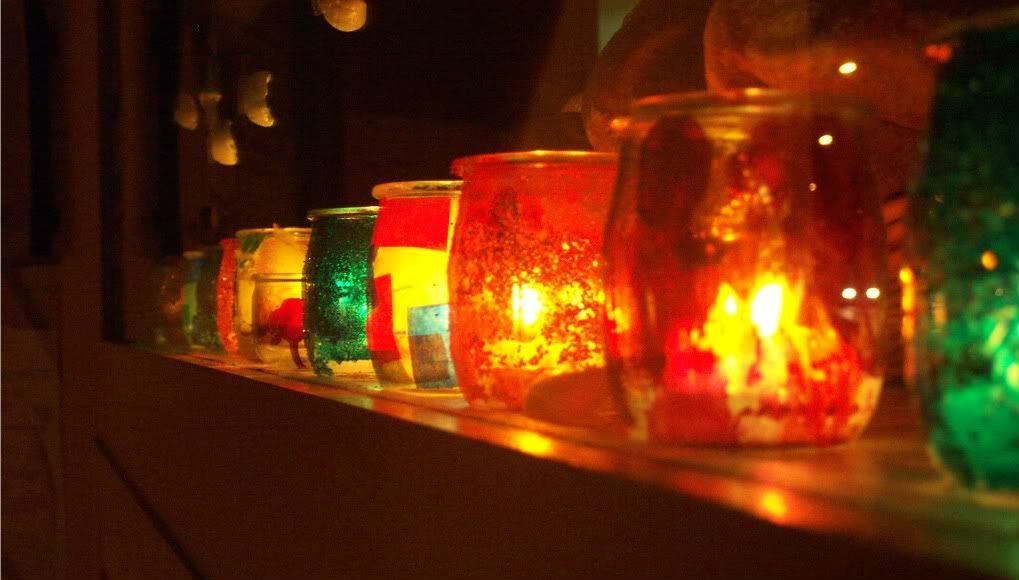
Every year on December 8th, the city of Lyon becomes a sparkling jewel as houses, businesses and apartment buildings are lit by millions of small votive candles on all their windowsills. The Fête des Lumières originated as a celebration of Mary, Jesus's mother. But over time, it has become for many a simple celebration of light and its beauty.
It's a fun way to really get into the Christmas spirit, with lights, candles, hot chestnuts and hot, spiced wine to drink in Lyon as well as in many of the little towns and villages surrounding the city. This year the celebration starts on December 8th and continues through the weekend.
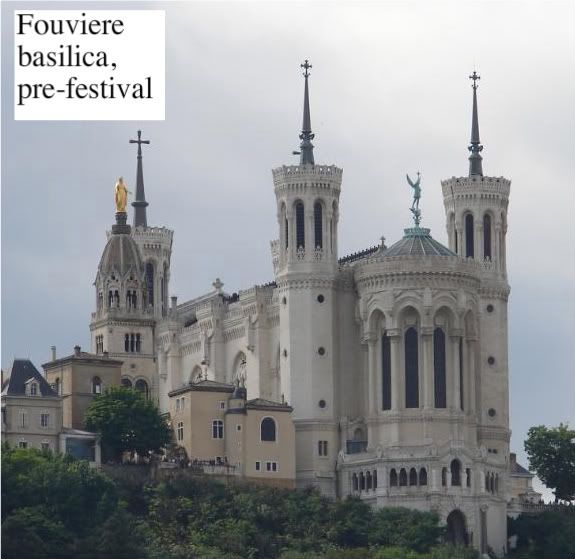
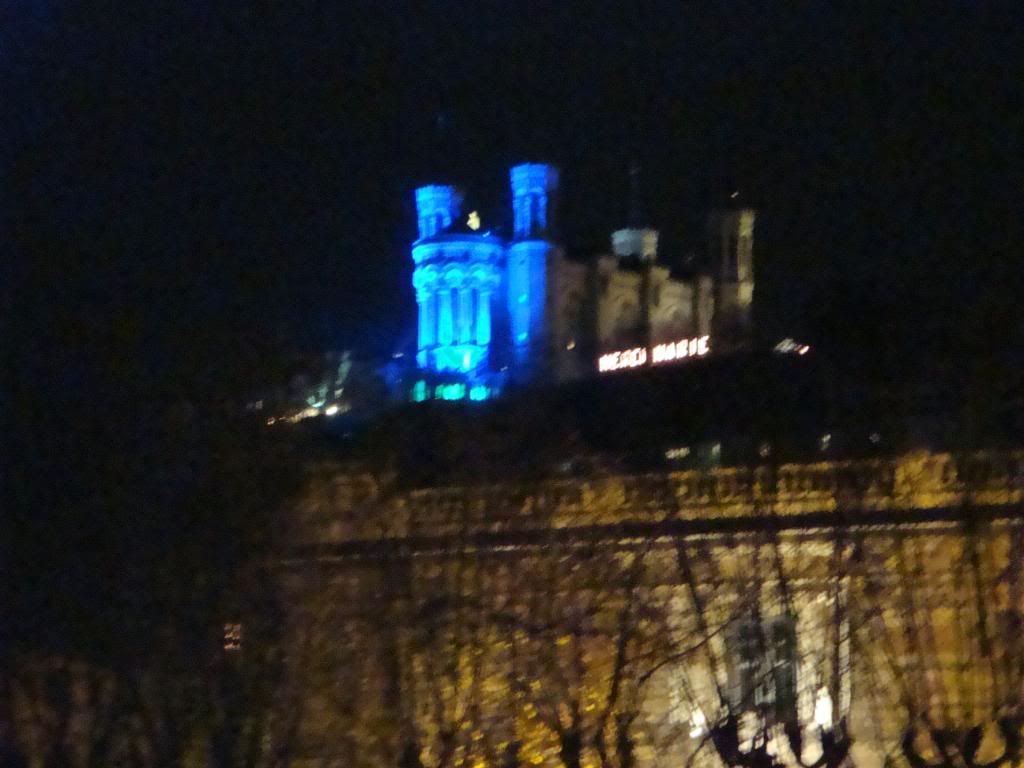 |
| ...and Fourviere during the festival |
Many of the little squares (les places) and churches become canvases for light displays. Some tell stories and others are more abstract. All the shows run idependently from one another throughout the festival. Each light show runs on a continuous loop, with a soundtrack. Some even include narration. Festival-goers are able to then vote online for the 'Best of Festival' award.
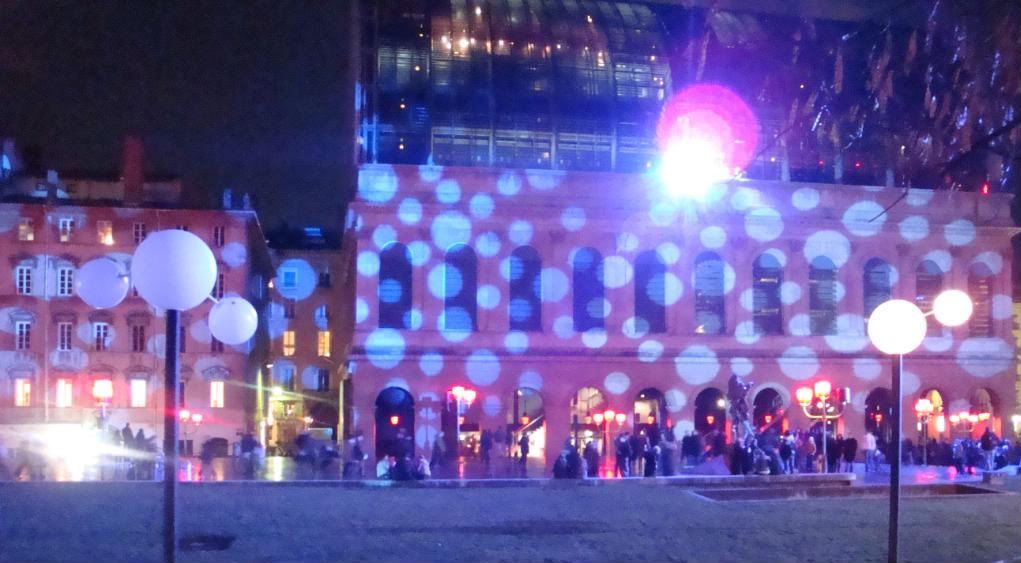
Lyon Opera House, before its show.
Walking along the streets on la presqu'île (presque=
almost, île= island, so presqu'ile means 'almost-island', or,
peninsula) there are lights of all kinds hung from almost anything, like this:
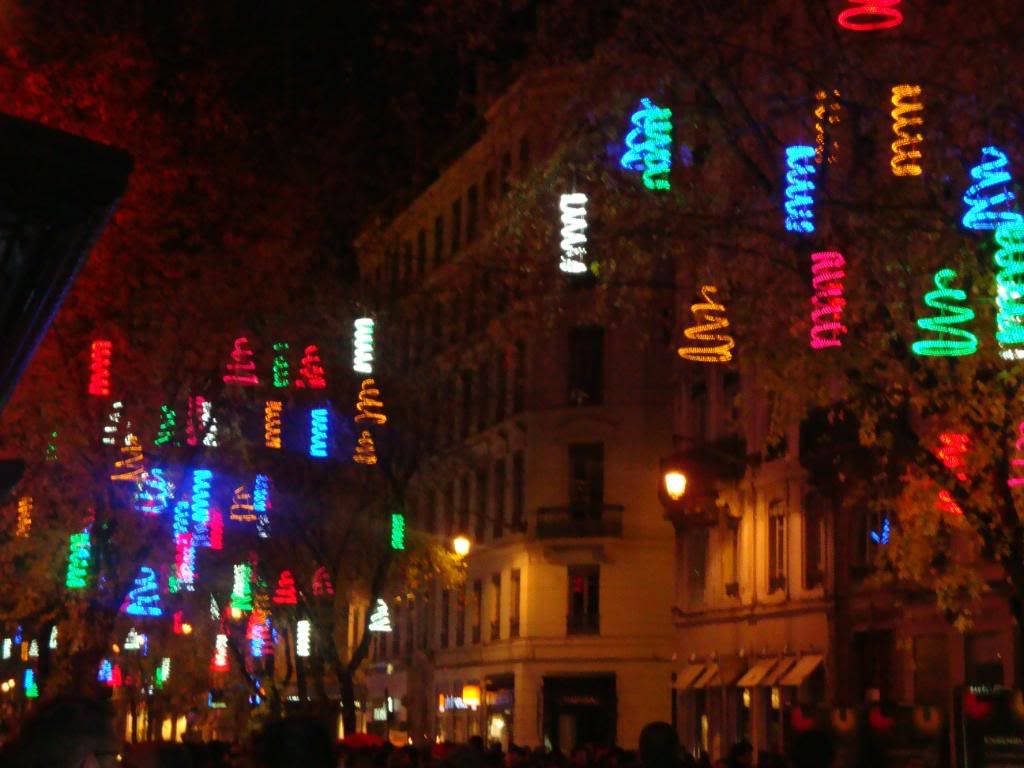
Have a light-filled holiday season!
Friday, November 4, 2011
Faire le tour du monde - en France !
Savez-vous qu’on peut rester en
France et faire le tour du monde ? Voici des noms de villages français qui
rappellent d’autres contrées plus lointaines !
- Allemagne-en-Provence, dans les
Alpes-de-Haute-Provence
- Argentine, en Savoie
- Barcelonne, dans la Drôme
- Les Déserts, en Savoie
- Montréal, dans le Gers
- Saint-Affrique, dans l’Aveyron
- Suisse, en Moselle
- Soudan en Loire-Atlantique
- Venise, dans le Doubs
- Vienne, dans l’Isère
Bon voyage !
Tuesday, October 18, 2011
Learn a foreign language!
"What do you call someone who speaks 2 languages? Bi-lingual. What do
you call someone who speaks 3 languages? Tri-lingual. What do you call
someone who only speaks one language? American."
Americans are often criticized by people in other countries because to be honest, we aren't all that great at learning foreign languages. But, to be fair, people usually rank their activities in priority order, giving greater weight to those things we feel we 'need' to do. In general, Americans don't feel a strong need to learn another language. Why?
The main reason is due to geography. Canada is mostly English-speaking, and Spanish, remains largely restricted to regions near the Mexican border (which is changing rapidly). The other reason is that English is quickly becoming the global language of science, commerce, and diplomacy (a title that used to be held by French). But it's different in other parts of the world. For example, here in France, my son is a Junior in high school. He started English classes, along with German, in 6th grade. He switched to Spanish in 8th grade. Most student learn at least 2 foreign languages (one of which is English), and it's not uncommon for students to pick up a third and sometimes even a fourth foreign language. Granted, Europe has many language zones packed into a relatively small space, so much of the language learning is done out of necessity. But we can learn an important lesson from the European language-learning model: if they can routinely learn additional languages, so can you!
As America becomes less isolated through travel and the Internet, geography will be less and less important. The sooner we understand that, the better. End result? We will see more and more of people learning new languages. What do you think about Americans and foreign languages? Do you feel that there are other countries, such as the UK, who are in the same linguistic 'boat'? Let me know in the comments section.
As America becomes less isolated through travel and the Internet, geography will be less and less important. The sooner we understand that, the better. End result? We will see more and more of people learning new languages. What do you think about Americans and foreign languages? Do you feel that there are other countries, such as the UK, who are in the same linguistic 'boat'? Let me know in the comments section.
You can get started by going to www.languageroutes.com to pick up resources for learning French, Spanish and even English (for those of you teaching ESL/ESOL).
Tuesday, September 20, 2011
Vive la carte postale !
À l’heure des mails et des SMS, la carte postale a toujours le même
succès en France ! Il s’en vend 332 millions chaque année et la plupart de
ces cartes sont envoyées pendant l’été.
Choisie avec attention en fonction
du destinataire, la carte postale a toujours la cote dans l’Hexagone. Ce petit
bout de carton de 165 centimètres rassure les parents, fait plaisir aux personnes
âgées, fait rêver les copines et rigoler les copains…
Au dos, les mots sont toujours les
mêmes : « Une petite pensée de ……où nous passons nos vacances »,
« Gros bisous de ….. où nous sommes pour une petite semaine »,
« Ici, tout se passe bien, le soleil brille et la mer est
chaude … ».
Pour information, sachez qu’on ne
peut pas écrire tout ce qu’on veut sur une carte postale. Vous risquez jusqu’à
1500 euros d’amende pour une injure par exemple.
À part ça,
bonne écriture !

Thursday, September 8, 2011
Tuesday, August 16, 2011
Petites pensées de la France en vacances …
Français ou anglais ?
Savez-vous qu’en visitant la France, les Anglophones ne se sentiront pas dépaysés avec le nom de certains villages au nom bien anglais ! Quelques exemples :
Brain : situé en Bourgogne, Brain compte seulement 26 habitants : les grands cerveaux sont rares !
Busy : petite commune du Doubs, Busy compte juste 530 habitants… : pas vraiment animé comme le laisse entendre le nom de ce village.
Condom : située dans le Gers, cette commune fait depuis longtemps sourire les Anglophones qui la visitent. Le maire de cette commune ne veut cependant pas assimiler sa commune aux préservatifs. En mars dernier, il a fait interdire la vente de préservatifs sous la marque « The original condom from Condom, France », refusant que le nom de sa commune soit utilisé à des fins commerciales. Les deux aristocrates français qui avaient lancé cette marque de préservatifs de luxe sur le marché américain ont dû en arrêter la fabrication. Pour la petite histoire, le siège de la société était basé à Condom, mais les préservatifs étaient fabriqués en Malaysie !
Cuts : commune de l’Oise, de 1 000 habitants…peu d’habitants pour un village au nom si court !
Hunting : situé près des frontières du Luxembourg et de l’Allemagne…D’après ce que l’on sait, les habitants de ce village ne pratiquent pas la chasse plus qu’ailleurs en France.
Noisy : c’est en fait le nom de six communes de France. Dans certains cas, ce sont des communes très tranquilles. D’autres au contraire, comme Noisy-le-Sec, près de Paris, sont entourées d’autoroutes… vraiment noisy !
Silly : plusieurs villages de France commencent par Silly : Silly-sur-Nied près de Metz, Silly-Tillard et Silly-le-long, dans l’Oise. Leurs habitants ne sont pourtant pas plus stupides que les autres !
En connaissez-vous d’autres ?

Savez-vous qu’en visitant la France, les Anglophones ne se sentiront pas dépaysés avec le nom de certains villages au nom bien anglais ! Quelques exemples :
Brain : situé en Bourgogne, Brain compte seulement 26 habitants : les grands cerveaux sont rares !
Busy : petite commune du Doubs, Busy compte juste 530 habitants… : pas vraiment animé comme le laisse entendre le nom de ce village.
Condom : située dans le Gers, cette commune fait depuis longtemps sourire les Anglophones qui la visitent. Le maire de cette commune ne veut cependant pas assimiler sa commune aux préservatifs. En mars dernier, il a fait interdire la vente de préservatifs sous la marque « The original condom from Condom, France », refusant que le nom de sa commune soit utilisé à des fins commerciales. Les deux aristocrates français qui avaient lancé cette marque de préservatifs de luxe sur le marché américain ont dû en arrêter la fabrication. Pour la petite histoire, le siège de la société était basé à Condom, mais les préservatifs étaient fabriqués en Malaysie !
Cuts : commune de l’Oise, de 1 000 habitants…peu d’habitants pour un village au nom si court !
Hunting : situé près des frontières du Luxembourg et de l’Allemagne…D’après ce que l’on sait, les habitants de ce village ne pratiquent pas la chasse plus qu’ailleurs en France.
Noisy : c’est en fait le nom de six communes de France. Dans certains cas, ce sont des communes très tranquilles. D’autres au contraire, comme Noisy-le-Sec, près de Paris, sont entourées d’autoroutes… vraiment noisy !
Silly : plusieurs villages de France commencent par Silly : Silly-sur-Nied près de Metz, Silly-Tillard et Silly-le-long, dans l’Oise. Leurs habitants ne sont pourtant pas plus stupides que les autres !
En connaissez-vous d’autres ?

Monday, June 6, 2011
Have you read English Now n°56?

Issue 55 of English Now magazine is in the newsstands! (Of course, it's also available from our website.) English Now is different from any other language learning magazine in that it its articles are written specifically for French-speakers learning English who are at beginner to intermediate level.
Each page has keywords translated into French. No need for a dictionary here - we've done it for you. Also, the feature articles are available in CD format with 60+ minutes of audio read by native English speakers from Britain, the US and Australia to help the learner tune their ear to different accents.
So what's in this issue?
- learn about coffee culture in the US and UK.
- discover London behind the scenes!
- get key vocabulary for an American summer trip.
- find out where English-speakers meet up with friends.
- ask for recommendations for the weekend in English.
- read about bestselling author Agatha Christie.
- get key phrases for shopping in the UK and US.
- learn about American dollars and cents.
- meet a British artist, an American scrapbooker and a British chex boxer.
- keep up-to-date on the latest news from English-speaking countries.
- test your comprehension with exercises!
Find out more here, or join us on Facebook.

Subscribe to:
Posts (Atom)


 Posts
Posts


